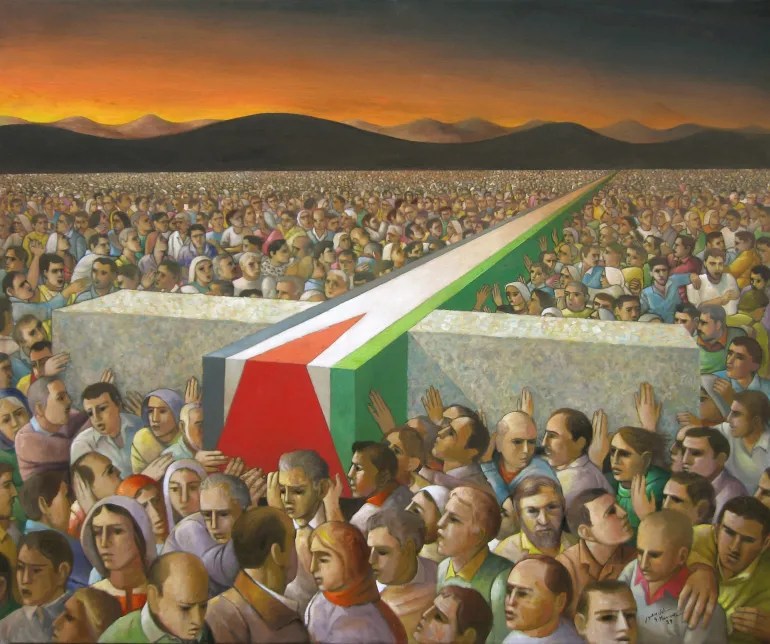

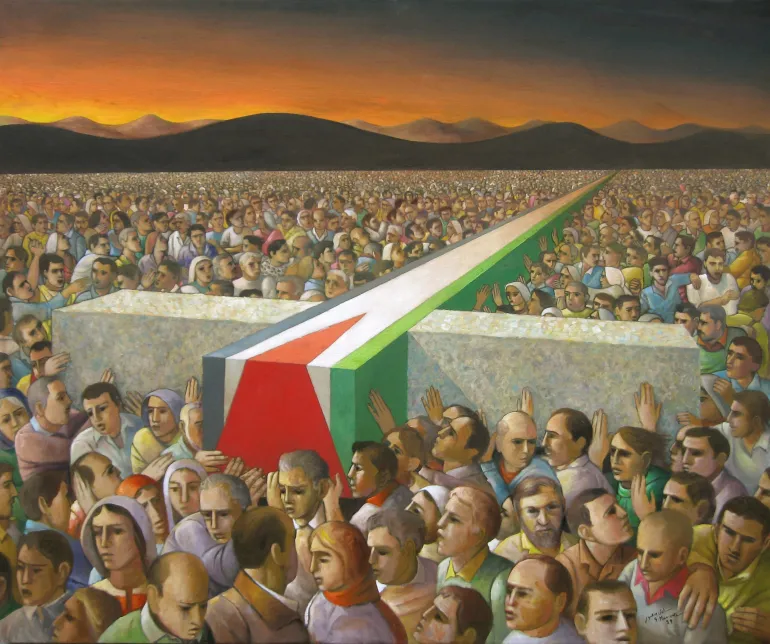
[Rituals Under Occupation by Sliman Mansour ]
The last several years of conflict and war have become emblematic of the passage from a longue durée crisis of international law to an outright rupture; which, given its colonial roots, has never – and perhaps, given its design could never have – lived up to its promises of universality. As the largest humanitarian crisis in recent history unfolds in Sudan, where over 12 million people have been displaced and genocidal violence is being perpetrated by the RSF and allied militias, the response by the ‘international community’ has been muffled and lacklustre. The destruction wrought on the lives of ordinary people has been on full display for the world to see. Throughout historic Palestine, the very public nature of the genocidal intent and actions enacted against Palestinians and their lived-built environment, the brazen impunity with which Israel has been allowed (by European states, Canada, the United States, and many others) to act, and also, the manner in which a set of ‘reconstruction plans’ that are both alegal and illegal are being put into place by dominant global powers points to a rupture that goes beyond the hypocrisies and contradictions embedded in the ‘rules-based international legal order’, as recently described in straightforward language by none other than Prime Minister Carney himself. At the same time, the current state of normative legal decay begs a question of those who believe in and subscribe to principles of liberal democracy, such as the rule of law, and whether they will act, when given the opportunity, to preserve them, even when it may be uncomfortable.
As activists and people of conscience locally and globally continue to organise against the ongoing genocide in Palestine, as well as against crimes against humanity and the environment, the language of international law and human rights can seemingly neither persuade mainstream public institutions and governments to take meaningful action beyond rhetorical condemnation, nor stretch far enough to adequately account for the forms of juridical violence being enacted on subject populations. We can take as an instructive example the renewed interest in the crime of apartheid as a focus for organising in support of Palestinian self-determination and freedom. Apartheid has, until recently perhaps, been considered one of the most inhumane forms of treatment, one of the gravest crimes against humanity. I write this opinion piece as students attempt to bring forward a motion at the Academic Senate of UBC Vancouver to cut ties with Israeli universities because of Israel’s violation on the prohibitions of apartheid and racial discrimination and their complicity in these specific crimes.
Defining Apartheid
Apartheid is defined in three different international law instruments, the Apartheid Convention, enacted in 1973 in specific response to apartheid in South Africa, the Convention on the Elimination of Racial Discrimination (Article 3), and the Rome Statute of the International Criminal Court.
The Human Rights Watch report on Israeli apartheid (discussed in more detail below) is worth quoting at length, for its pithy definition of the core elements of the legal concept of apartheid:
The crime of apartheid under the Apartheid Convention and Rome Statute consists of three primary elements: an intent to maintain a system of domination by one racial group over another; systematic oppression by one racial group over another; and one or more inhumane acts, as defined, carried out on a widespread or systematic basis pursuant to those policies.
Among the inhumane acts identified in either the Convention or the Rome Statute are “forcible transfer,” “expropriation of landed property,” “creation of separate reserves and ghettos,” and denial of the “the right to leave and to return to their country, [and] the right to a nationality.”
The Rome Statute identifies the crime against humanity of persecution as “the intentional and severe deprivation of fundamental rights contrary to international law by reason of the identity of the group or collectivity,” including on racial, national, or ethnic grounds. Customary international law identifies the crime of persecution as consisting of two primary elements: (1) severe abuses of fundamental rights committed on a widespread or systematic basis, and (2) with discriminatory intent.
The language of apartheid has been used for decades to name the totality of settler colonial violence across historic Palestine. As Ilaria Giglioli reported in 2010, ‘Israeli Apartheid Week’ began in 2005 in Toronto, Canada, initiated by the Arab Students’ Collective at the University of Toronto. A group of student activists from the Arab Student Collective at the University of Toronto and York University launched the first ever Israeli Apartheid Week (“IAW”), to both “break the wall of silence and misrepresentation around what was happening in the occupied West Bank and Gaza Strip” and also to contextualise military violence directed against Palestinians within the larger reality of Israel’s apartheid practices. The initiation of IAW allowed activists to make connections between the building of the Apartheid Wall through the West Bank, home demolitions in the West Bank and East Jerusalem, to the right of return of Palestinian refugees, and the violation of the civil and political rights of Palestinian citizens of Israel.
Within 6 years, the event had spread to 40 cities on 5 different continents. While the focus was not on the legal definition of apartheid, the movement explored the political realities of racial apartheid in Israel and the specific policies and mechanisms (many of them legal ones) that had created an apartheid regime. The use of the language of apartheid was part of a strategy to illuminate the similarities between the lived conditions of Palestinians and apartheid in South Africa and the forms of political solidarity arising from this commonality. In 2012, the late Archbishop Desmond Tutu stated that the comparison was nevertheless limited, in that Israeli control over Palestinians ‘was in many instances worse’ than apartheid in South Africa. The impunity offered by the West to Israeli politicians was a key factor, in his view, for the extreme violations of Palestinian human rights.
It took international and Israeli human rights organisations some time to catch up. In 2021, B’Tselem, the Israeli Information Center for Human Rights in the Occupied Territories released their report, ‘A regime of Jewish supremacy from the Jordan River to the Mediterranean Sea: This is apartheid.’ In this report, B’Tselem concludes that the Basic Law ‘Israel – the Nation State of the Jewish People’, enacted in 2018 by the Knesset, which articulates the ethnic-religious identity of the state of Israel as exclusively Jewish, was a defining moment in their conclusion that Israel is an apartheid state. Moreover, the law also defines Israel as Eretz Israel, or the “Land of Israel”, which includes all of the West Bank and East Jerusalem. Adalah, the leading legal organisation for Arab minority rights in Israel, concludes that this effectively forecloses the two-state solution and defines the realisation of national self-determination as solely for the Jewish people across the occupied West Bank, Syrian Golan Heights and East Jerusalem. For anyone wanting to understand in laymen’s terms how the International Court of Justice (ICJ) reached the conclusion that Israel is violating the international legal prohibition on racial segregation and apartheid in their 2024 ruling, the B’Tselem report is an excellent entry point
In April 2021, Human Rights Watch released a report titled: ‘A Threshold Crossed: Israeli Authorities and the Crimes of Apartheid and Persecution’. This report also examines Israeli practices across Israel (within 1948 borders) and the Occupied Palestinian Territories as a whole, and focuses on the legal threshold for apartheid as defined in international law. Thee authors of the report conclude that “the Israeli government has demonstrated an intent to maintain the domination of Jewish Israelis over Palestinians across Israel and the OPT. In the OPT, including East Jerusalem, that intent has been coupled with systematic oppression of Palestinians and inhumane acts committed against them. When these three elements occur together, they amount to the crime of apartheid.” (emphasis added).
In February 2022, Amnesty International released a report titled ‘Israel’s apartheid against Palestinians: cruel system of domination and crime against humanity’. In this very detailed and extensive report, Amnesty concludes that:
Israel’s system of institutionalized segregation and discrimination against Palestinians, as a racial group, in all areas under its control amounts to a system of apartheid, and a serious violation of Israel’s human rights obligations. Almost all of Israel’s civilian administration and military authorities, as well as governmental and quasi-governmental institutions, are involved in the enforcement of a system of apartheid against Palestinians across Israel and the OPT and against Palestinian refugees and their descendants outside the territory. (emphasis added)
As we will see below, ‘governmental and quasi-governmental institutions’ includes Israeli universities.
However, as early as 2009, a multinational team of researchers from Ireland, South Africa, Palestine and Israel under the auspices of the Human Sciences Research Council of South Africa, Al-Haq, the pre-eminent Palestinian human rights organisation, and Adalah (the Legal Centre for Arab Minority Rights in Israel) released a 300 page report titled “Occupation, Colonialism, Apartheid?: A Re-Assessment of Israel’s Practices in the Occupied Palestinian Territories under International Law”. The team found that “through its laws and practices in the OPT, has breached the international legal prohibitions of both colonialism and apartheid.”
Al-Haq released their own report on Israeli apartheid in November 2022, the result of a collaboration with many leading Palestinian civil society organisations seeking to fill a gap in the reports of Israeli and international human rights organisations. Specifically, they sought to show how Zionism as a political ideology had come to utilise apartheid practices as one element of a settler colonial modality of rule across the OPT and within the boundaries of Israel.
Finally, in July 2024, the International Court of Justice concluded that the ongoing Israeli occupation of the West Bank, East Jerusalem and the Gaza Strip is illegal, and specifically, that Israel’s “legislation and measures impose and serve to maintain a near-complete separation in the West Bank and East Jerusalem between the settler and Palestinian communities. For this reason, the Court considers that Israel’s legislation and measures constitute a breach of Article 3 of CERD (para 229). In other words, Israel is in violation of Article 3 of the Convention on the Elimination of Racial Discrimination, which provides that “States Parties particularly condemn racial segregation and apartheid and undertake to prevent, prohibit and eradicate all practices of this nature in territories under their jurisdiction.”
The Complicity of Israeli Universities
Israeli universities are implicated in apartheid practices in three key ways. First, since the founding of the state of Israel in 1948, universities have been built as part of state strategies to illegally appropriate Palestinian land. Second, Israeli academics and disciplinary fields have been active participants in creating justifications and narrative support for a settler colonial project, apartheid practices and the inhumane treatment of Palestinians. Third, Israeli universities have long supported and given space to research and development of military and security programmes, lethal hardware and the training of soldiers. These are facts, not myths or allegations.
On the first point, as Maya Wind writes, from the 1960s, the Israeli state built universities in order to expand Jewish territorial control over historic Palestine and forced Palestinian displacement (one of the key aspects of the legal dimensions of apartheid). She writes that “new Israeli universities were built to anchor this territorial and demographic project, their campuses constructed as strategic regional outposts that impelled both Palestinian enclosure and Jewish settlement expansion.” For example,
[i]n the largest city of the Palestinian-majority, Galilee, Israel developed and granted full accreditation to the University of Haifa in 1972. That same year, Israel built Ben-Gurion University in the center of the Naqab, the region known in Israel as the Negev and most sparsely populated by Jewish-Israelis, where the Israeli state has had a consistent policy of dispossessing Bedouin communities of their land. After 1967, Israeli universities created facts on the ground in the form of permanent Jewish settlements in the occupied Palestinian territory (OPT). Hebrew University expanded its Mount Scopus campus into occupied East Jerusalem, while Ariel University received full accreditation in 2012 as the newest Israeli university in the occupied West Bank. For over a century, Israeli universities were planned and built to serve as pillars of regional demographic engineering and Palestinian dispossession.
On the second point, the lack of academic freedom for Palestinians critical of the occupation and the genocide reached a nadir of sorts when Professor Nadera Shalhoub-Kevorkian was arrested, detained and eventually forced to resign her position at the Hebrew University Faculty of Law (which has a faculty exchange with Allard Law Faculty, UBC) because of criticism of the genocide she expressed on a podcast. This was at odds with Israeli universities’ efforts to manufacture broad based support for state policies across Israeli campuses and beyond. Since October 2023, Palestinian students have been suspended by Israeli universities, beaten, harassed and detained on campus for expressing dissent and criticizing the genocide. The notion that racial discrimination, the violation of basic rights and the degrading treatment of Palestinians does not reach the university campus is a myth that needs to be thoroughly dispelled. And this is to say nothing of the militarised targeting of Palestinian students at Birzeit University in the West Bank. It is to say nothing of the total or partial destruction of each and every university in the Gaza Strip, and the lethal targeting of Palestinian scholars, artists and university administrators.
On the third point, many Israeli universities have long had ties to the Israeli military, part of the state apparatus indicted for committing genocide, not to mention for facilitating apartheid practices. The University of Haifa for example is host to the Israel Defense Academy. The Hebrew University, Technion, Tel Aviv University, all cooperate closely with the military and defence establishments. These are facts, not myths or allegations.
Whither the Rule of Law?
With so many clear and unequivocal legal analyses of Israeli practices against Palestinians that amount to apartheid and crimes against humanity, it is important to query the sustained refusal of the Academic Senate at UBC to cut or suspend ties with Israeli universities. While the double standards and racism inherent in the outcomes of civil (if poorly informed) debates have been pointed out by UBC faculty and students, I want here to pose a different question, which concerns the commitment of the University Senate to the rule of law. It’s not a question I’m usually that interested in, as the rule of law has been used historically as a key justification for colonial rule over the ‘non-West’ and for the subjugation of Indigenous and colonised people; but in the liberal political imaginary that governs the norms and values that the Academic Senate is supposed to, in theory at least, uphold, lies the idea that when a court renders a judgment, its findings are respected and that public institutions will abide by those rulings. In this case, the ICJ ruling of July 2024, the thousands of pages of meticulously collected and analysed evidence by major Palestinian, Israeli and international human rights organisations – all of which have concluded that Israel is violating the prohibition on apartheid and inhumane treatment – and the clear connection between Israeli universities as public institutions that perpetuate and are implicated in state practices of apartheid and racial discrimination, ought to lead the Academic Senate to suspend or cut ties with Israeli institutions. The specific evidence that links Technion, Tel Aviv and Hebrew Universities to the military and security establishment is by now well established. When UBC chose in 1986 to partially divest from apartheid South Africa, it did not do so because of any kind of strict legal liability, but because apartheid went against the values of the UBC community and local, national and international laws prohibiting inhumane and degrading treatment based on race.
A no-vote on a motion proposing to cut ties with Israeli institutions would not only be further proof (as if proof were needed) of the continuing ‘Palestine Exception’ but in fact, another nail in the coffin of the notion that the rule of law guides the behaviour and norms of our institutions and their leaders. Perhaps it would only be in keeping with the actions of some of our political leaders. The recent turn by BC Premier David Eby, who has attempted to suspend or ‘pause’ certain aspects of the Declaration on the Rights of Indigenous People (“ DRIPA”), because as it turns out, they are rather inconvenient from a settler perspective is one example. Perhaps it is in keeping with Prime Minister Mark Carney’s about-face in his response to the illegal war of aggression being waged on Iran by Israel and the United States. While at first recognising its illegality, the PM then went on to state that ‘with regret’ he would nonetheless support the illegal war because he agrees with Israel and the US that Iran should not possess a nuclear weapon. We have entered a conjuncture where even lip service to the international legal order is no longer paid and instead, political leaders such as our own openly acknowledge the collapse of the international ‘rules-based order,’ inaugurating an emergent (dis)order that facilitates authoritarian tendencies and worse.
It is a cruel irony, then, that what is happening in Palestine today is indeed, so much worse than apartheid. The Death Penalty law that was recently passed by the Knesset, which only applies to Palestinians, is more consistent with racial fascism than apartheid. A report by a group of UN experts concludes that “[o]ther aspects of the legislation, including military trials of civilians, systemic due process violations, and execution by hanging make it irreconcilable with the absolute prohibition of torture and other cruel, inhuman or degrading treatment or punishment.” Having personally observed a military tribunal in the occupied West Bank in 2011, I can testify that the due process violations were multiple, obvious and clearly prejudicial to the Palestinian accused. Beyond procedural fairness, we don’t have to imagine what current conditions in Israeli prisons are like; the latest report by the UN Special Rapporteur Francesca Albanese informs us that Israeli detention facilities, particularly since October 2023, are marked by the systematic torture of Palestinian prisoners and that torture takes places widely, in non-custodial settings as well.
The cost of the destruction of the lived built environment in Gaza, in Beirut and southern Lebanon, and now, in Tehran, has a human and generational cost that has become part of a globalised economy based on permanent warfare against civilian populations, that is being normalised, in part, through the impunity with which it is met. Professor Joel Beinin, writing about the resilience of the Israeli economy, notes that
[a]s might be expected, Israel’s military-surveillance-industrial complex has remained strong. Israel is a world leader in the “new military urbanism” — crowd control, border surveillance, and counterterrorism — that has burgeoned since 9/11. For many of its customers, Israel’s role in genocide is a selling point rather than a problem.
While profiteering from war is hardly a new phenomenon, the military urbanism Beinin refers to, drawing on the work of Stephen Graham, has a profit margin dependent on the level of devastation its technologies have wrought, proving it to be battle tested to a level that far exceeds legal and moral limits. As mentioned above, universities play a key role in this economy of occupation and genocide.
The Academic Senate at UBC has a choice to make in terms of the values, ethics and norms it will choose to uphold should the motion on suspending ties ever make it to a meeting for debate. (And the resistance among some senators to even having a special meeting to discuss and debate the motion certainly does not bode well for a capacious understanding of what the public university is for, and its role in upholding free and rigorous debate on precisely such matters). Unlike the last time this came up, in June 2024, this motion more directly implicates the legal obligations of the University. If Palestinian, Arab or Muslim students or faculty were to travel on exchange to an Israeli university, they would risk detention, imprisonment, deportation, harassment, physical violence, and prosecution, in a way that other students and faculty would not. Canadian students and faculty would also face discrimination based on freedom of expression and political belief, given the law passed in February 2025 by the Knesset, the Entry to Israel Law (Amendment No. 4), which bars entry to anyone who “has called for a boycott of the State of Israel” or anyone who has “supported the prosecution of Israeli citizens in foreign courts or international tribunals for actions taken in their official capacity in the Israeli military or security agencies.” (The latter of which has been a strategy to hold Israeli soldiers who hold dual citizenship to account for war crimes). In fact, entry through Tel Aviv airport is currently prohibited altogether for Palestinian Canadians. On its face, such faculty and student exchanges fall or risk falling afoul of the BC Human Rights Code and UBC anti-discrimination policies, which the Academic Senate has a duty to uphold and abide by.
Beyond this, there is the question of standing on the right side of history and taking action where one can to bring an end to apartheid practices and racial discrimination, particularly in places that UBC has direct affiliations with. A kind of Sartrean bad faith seems to pervade our institutional contexts. Having watched many of my colleagues in the law school do their best to not even discuss the matter, it is clear and obvious that many people foreclose any possibilities of even entertaining positive action where there is a risk of alienating or disturbing people subscribing to Zionist views, or even the ‘two-siders’ or even those who don’t quite see Palestinians as deserving of equal rights. When scaled up, this disavowal of reality – and crucially, to act where possible to effect positive change – offers some explanatory value for how and why liberal legal norms are in a state of accelerating decay. Whilst the moral and ethical arguments have similarly not swayed many faculty senators, one would hope that the duty to uphold the rule of law might carry some weight, or even be understood as the basic minimum required for equality between all members of the UBC community. To fail on this basic matter would be more than merely regrettable.

