
Israel’s systematic destruction of educational institutions and infrastructure, and deliberate targeting of scholars and academics in Gaza, is increasingly being recognised around the world as a practice of scholasticide (with some preferring to speak of “educide” or “epistemicide”). Like the ethnic cleansing and genocidal violence that we have witnessed since October 2023, this phenomenon is rooted in a decades-long war on Palestinian culture by the Israeli state. From your vantage point as a scholar and educator in Palestine, what is your understanding and analysis of scholasticide, both in its long history and in its current manifestation?
The stark and shocking features of scholasticide in Gaza have been manifest in the destruction of all higher education institutions (HEIs), which were attacked by Israeli drone strikes, high explosive anti-tank weapons, and direct and indirect air strikes. Such indiscriminate attacks deliberately placed students and lecturers on the front line of the conflict and left many sites littered with the explosive remnants of war. Given the level of damage at some sites, students and staff could face ongoing and serious risks to their safety. Large-scale damage and destruction to HEI buildings, facilities and equipment during the bombardment totalled damages amounting to more than $16 million, while the total cost of the damage and destruction to Gaza’s homes and infrastructure has been estimated at $7.8 billion according to a UN report. At the time of writing [April 2024], over 100 academics have lost their lives as well as thousands of their students. This large-scale ethnic cleansing policy is not new to the Israelis, it is part of a history that is hostile to education in general and higher education in particular.
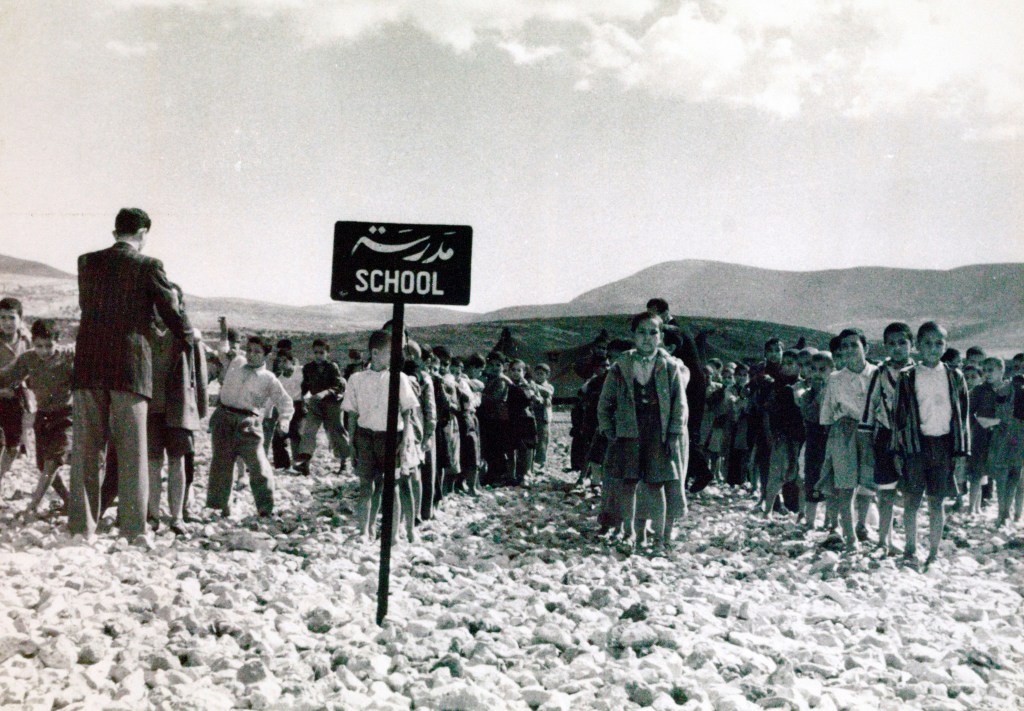
Many Palestinian education institutions emerged as schools and colleges in the early 20th century. For example, Birzeit University was established in 1924 as a girls’ school, turned into a college in 1942, then a university in 1972. An-Najah University was established as a boys’ school in 1918, turned into a college in 1941, then a university in 1977. Bethlehem University was set up in 1909 as a boys’ school and was turned into a university also in 1972. Palestine Technical University – Kadoorie was established in 1931 as an agricultural school.
One might wonder why most of these institutions established in the early 20th century only became universities in the mid-seventies. Following the colonization of the West Bank and Gaza Strip in 1967, Palestinians lost direct access to the rest of the Arab World and its educational institutions. To promote the formation of ‘white collars’ in the Occupied Territories after 1967, the Israeli Authority encouraged the establishment of universities in the West Bank and Gaza to spur white-collars workers to leave their land and seek jobs in the Gulf or outside Palestine, hence the proliferation of higher education institutions in the West Bank and Gaza but not inside Israel proper for 1948 Palestinians.
When higher education institutions turned out to be mechanisms to resist colonialism, to strengthen people’s steadfastness against colonization, to articulate the narrative of Palestinian dispossession and national identity and became instruments for resistance, the Israeli authority targeted these institutions through a web of different tools and mechanisms.
The freedom of Palestinian universities has been repeatedly undermined by the expulsion of academics and students and the threat of closure by Israeli authorities. During the first Intifada (1987-1992), all Palestinian universities were forced to close for extended periods under military orders. Birzeit University, for example, was closed for 51 consecutive months. Bethlehem University was closed for 36 months, and same for other universities.
After the second Intifada (2001 onwards) more than 700 roadblocks and barriers were erected across the West Bank to restrict students and staff mobility.
The fragmentation of the West Bank and Gaza strip has caused Birzeit University, for example, to lose its national character, as students face increasing difficulties in accessing the university. For many years, students have had to content themselves with whatever their local universities had to offer in terms of education, which resulted in curbing and distorting talent.
As the Israeli occupation controls the population registry and the borders of the occupied Palestinian territories, it has de facto control over which students and faculty members can access Palestinian universities. Hanna Nasir, the first president of Birzeit University, was deported and sent into exile for 19 years between 1974 to 1993.
In 2000, there were 350 students at Birzeit University from Gaza. Some of these students were deported, while others stayed in the West Bank and risked being deported at any moment. By 2005, the number of Gaza students dropped to 35. Today, only four students from Gaza study at Birzeit.
Military assault is another mechanism to target Palestinian higher education. In the past 28 years, the Israeli occupation forces have stormed Birzeit University campus 19 times. On March 7, 2018, an undercover Israeli unit entered Birzeit University while students were on campus and kidnapped Omar Kaswani, a 24-year-old political science student and then president of the student council. On March 26, 2019, the same unit infiltrated Birzeit University campus early in the morning and kidnapped three students. On January 10, 2022, Israeli forces fired live bullets at a group of students at the eastern entrance of the university, injuring one of them and arresting five students. All five students were part of the student movement at that time. On April 13, 2022, Israeli forces raided Kadoorie University campus and shot at students injuring three. According to Adameer, 86 university students were arrested and detained in 2022. Since 1982, more than 2000 students from Birzeit University have been imprisoned by the Israeli occupation. Around 70 students remain in detention. 15 of these students are held indefinitely without being charged under administrative detention. To date, 30 Birzeit University students were murdered by the Israeli occupation. On November 29, 2022, brothers Dhafer and Jawad Al-Rimawi were murdered by the Israeli forces. This came only weeks after student Amer Halabieh was also murdered by the Israelis. [University raids continue, with the latest occurring on November 26, 2024 – DPC]
Censoring and controlling Palestinian narratives is another mechanism of Israeli power. Over the years, Israel has vetoed Palestinian texts at universities under the heading of ‘inappropriate’ books, meaning those books which basically dealt with Palestinians’ narratives about their own history. This also extends to school textbooks. It is important to note that the European Union (EU) changed its position on the Palestinian curriculum between 2002 and now. Earlier, the EU contended that Palestinian curriculum was ‘free of inciteful material against Israel’. Now under Israeli pressure, the EU argues that the same Palestinian curriculum is full of problematic material that could incite ‘hate speech and violence’. Currently, Israel is threatening to not recognize Palestinian university degrees, which means that Palestinians from areas colonized in 1948 and Jerusalem will not be able to work in Israel anymore. Their Palestinian degrees would become invalid.
Palestinian universities have been fulcrums of resistance while also being targets not just of repression but also of capture and broader processes of domestication and ‘NGOization’. How do you view the current relationship between academic life and Palestinian liberation in the shadow of an increasingly brutal occupation regime, ethnic cleansing, and genocide in Gaza?
I have to admit that the Oslo agreements and the so called ‘peace process’ affected to some extent the role of academics in the struggle for liberation. The so-called ‘state building process’ attracted an important number of academics who used to be active in Palestinian civil society activities against the occupation, whether in the field of media and communication, practices of sumud or ‘steadfastness’ to support their communities, the organizing of debates and other forms of theoretical and political reflection. The so-called ‘state building’ and ‘peace building’ processes shifted the direction of these previous activities, leading the same people to work as bureaucrats, advisors, or experts to benefit the ‘state building’ process, as if the process needed the technical skills of experts to ‘solve’ Palestinian problems. The same can be said for the ‘peace building’ process that consumed the time and efforts of many academics, including myself, to ‘convince’ Israeli academics of the justice of our case and to ‘break the psychological barriers’ between the two parties. These sorts of activities were very much encouraged and pushed by many Western governments and donors, as well as by the Palestinian authority. The Second Palestinian Intifada in 2002 broke all these illusions and showed clearly the persistence of Israel’s settler-colonial nature, evident in its land-grabbing, suffocating Palestinians by means of multiple administrative measures (border control, mobility control, population control), as well as through exorbitant violence by army and settlers. These illusions also came to an end through the continuing and persistent shift to the extreme right of the Israeli society and polity – besides the fallacy of believing that a colonized people can build an independent state or achieve any tangible development. In the meanwhile, the student body was moving towards greater radicalism, serving as a beacon for where the focus of activism should be placed. The University administration, the student body and the university union were adamant to contain any attempt at ‘normalization’ between Palestinian academics and Israeli academics. Thus, in 2005 PACBI (Palestinian Academic and Cultural Boycott of Israel) was established, and the movement stood as an important barrage against any attempt to ‘normalize’ Palestinian life under settler-colonialism. Besides, many ‘experts’ from academia realized the fallacy of seeking to build a state that represents Palestinian aspirations for independence, freedom and development, given the policing and repressive role of the Palestinian Authority (PA). Dr. Beshara Doumani, Birzeit University president (2021-2023) expressed this shift clearly in his inauguration speech when he said that the University’s main role is to achieve national liberation and not to produce state bureaucrats.
Education is a mechanism to reconnect the Palestinian people to their lands and rights, and to provide them with tools of critical analysis that enable them to contextualize their knowledge of the coercive environment foisted on them. Education is also a mechanism to encourage our involvement in the struggle for decolonization, liberation and a just solution.
Palestinian universities, as well as civil society more broadly, were crucial to the launching of the Boycott Divestment and Sanctions (BDS) movement as the most prominent and contested vehicle for international solidarity with Palestinian struggles against occupation, settler colonialism and ethnic cleansing. What is your judgment about the state and prospects of international solidarity? In particular, how do you see the role of academics and universities internationally in supporting Palestinian struggles? What do you think are the shortcoming or limitations of academic solidarity, and how could it be refined or amplified?
International solidarity with Palestine is growing and it is becoming an important tool to pressure politicians in their respective countries and to stand against the shameful political stands of many governments. At present, the international solidarity movement is the main hope for Palestinians to still believe in any human rights convention or humanitarian laws, especially when they see how all these international humanitarian tools are utilized and instrumentalized in a very biased and unethical way. In this regard, I see the role of academics as very crucial in introducing the case of Palestine in their syllabi and research topics; in raising their voice publicly in the media and in taking political stands; in knitting webs of relations with Palestinian academic institutions to conduct joint research, joint publications, joint conferences; offering scholarships and fellowships; offering scientific resources to Palestinian academic institutions; organizing annual tours to visit Palestinian academic institutions and to see the facts on the ground. To follow the BDS directives: refuse to review any research work by Israeli academics; refuse to participate in any academic activity organized by an Israeli academic institution; refuse to invite any Israeli academic who adheres to Zionism as an ideology; divest any resources given to Israel academic institutions; organize ‘free spirit’ tribunals to judge and sanction Israeli state policies (by law professors, free judges, etc.) away from the superpower’s influence. Large numbers of well-established academics demonstrating in support of Palestine is an important stand that can attract media attention.
I still think that international academics can offer more solidarity with Palestine if they follow their conscience instead of their interests, especially when Israeli supporters have the tools to hurt those who take an ethical stand for Palestine – but acting collectively is important to take a stand in the face of pressure from the Israel lobby.
Notwithstanding global attention, protest and debate elicited by the most recent war on Gaza, the voices, analyses, and theoretical perspectives of Palestinians are often absent in the ‘global North’, with the limited and partial exception of some intellectuals and academics in the Palestinian diaspora. What do you see as the effects of this silencing or marginalisation? More constructively, in view of your own experience and analysis of the current conjuncture in Israel’s colonial and genocidal war on the Palestinian people, what do you think are the critical issues that international academics in solidarity with Palestine should attend to? Though historically-informed critiques of Zionism and settler-colonialism have now made inroads into a progressive common sense – while being objects of attack on campuses and in the media – are there dimensions of Israeli state violence and of the reality of resistance that you think have not been properly attended to in international discussion?
Silencing the Palestinian voice and marginalizing it has left deep traces on academia. We can start by the acquisitions of Western universities’ libraries, which are inundated by references supporting the Israeli narrative from a ‘subjective and scientific’ point of view with few or a minimal number of references supporting the Palestinian perspective. This might be related, beside the possible bias of Western librarians, to the fact that many important references are written in Arabic and would need to be translated or introduced to Western scholars working on the Palestinian case.
Another reason for the silencing and marginalization of the Palestinian voice is the ‘frame’ that the Palestinian question is put into. Israelis manage to feed the media, academia, etc., piles and piles of lies and fabricated narratives, thus the Palestinians are always put in a frame that they have to ‘respond’ to, to ‘deconstruct’ these lies and fabrications, sometimes at the expense of telling their own stories or presenting their own realities.
The fact that in most of Western academia the question of Palestine comes under disciplines such as Middle East studies, Oriental studies, Arab studies, or even Palestine studies, etc., plays a role in distorting the study of the Palestinian question, which should be part of the study of settler-colonialism. Till this moment, there are many facets of the Palestinian question, as a settler-colonial case, that have not been studied yet or not enough, such as: environmental aspects, anthropological aspects, archeological aspects, gender aspects, etc. More theoretical analysis and theoretical development are needed to capture the Palestinian case, since we are still witnessing confusion on how to theoretically grasp it – with apartheid, sociocide, politicide, Nakba, all being used to qualify it.
I think what has not yet been properly covered regarding Israeli violence is the questioning of Zionism as a violent, racist and discriminatory ideology; Jewish supremacy and racism are still not fully tackled, due to fears about the accusation of antisemitism. Besides, many aspects of Palestinian forms of resistance are still seen as ‘acts of terrorism’ whether throwing stones, using weapons, marches of return, suicide bombing, etc. The point is that the legitimacy of Palestinian resistance, in all its forms, is still debated while the root cause for the legitimacy of any form of resistance, which is the settler colonial project, is blurred.
An Associate Professor at Bir Zeit University. Jad served as the director of the Women’s Studies Institute from 2008-2013. She is a founding member of its women’s studies MA program and she is a founding member of the first Ph.D. program in Social Sciences at Bir Zeit University. She has written books and papers on the role of women in politics, Palestinian women and the relationships among them, Islam, and NGOs. Jad is the author of Women’s Activism: Nationalism, Secularism, Islamism (Syracuse University Press, 2018), and ‘Gender in a Fragmented non-Sovereignty’, in Deniz Kandiyoti (ed.), Women, Islam and the State Revisited (Edinburgh University Press, 2019).
 Decolonise Palestine Collective